
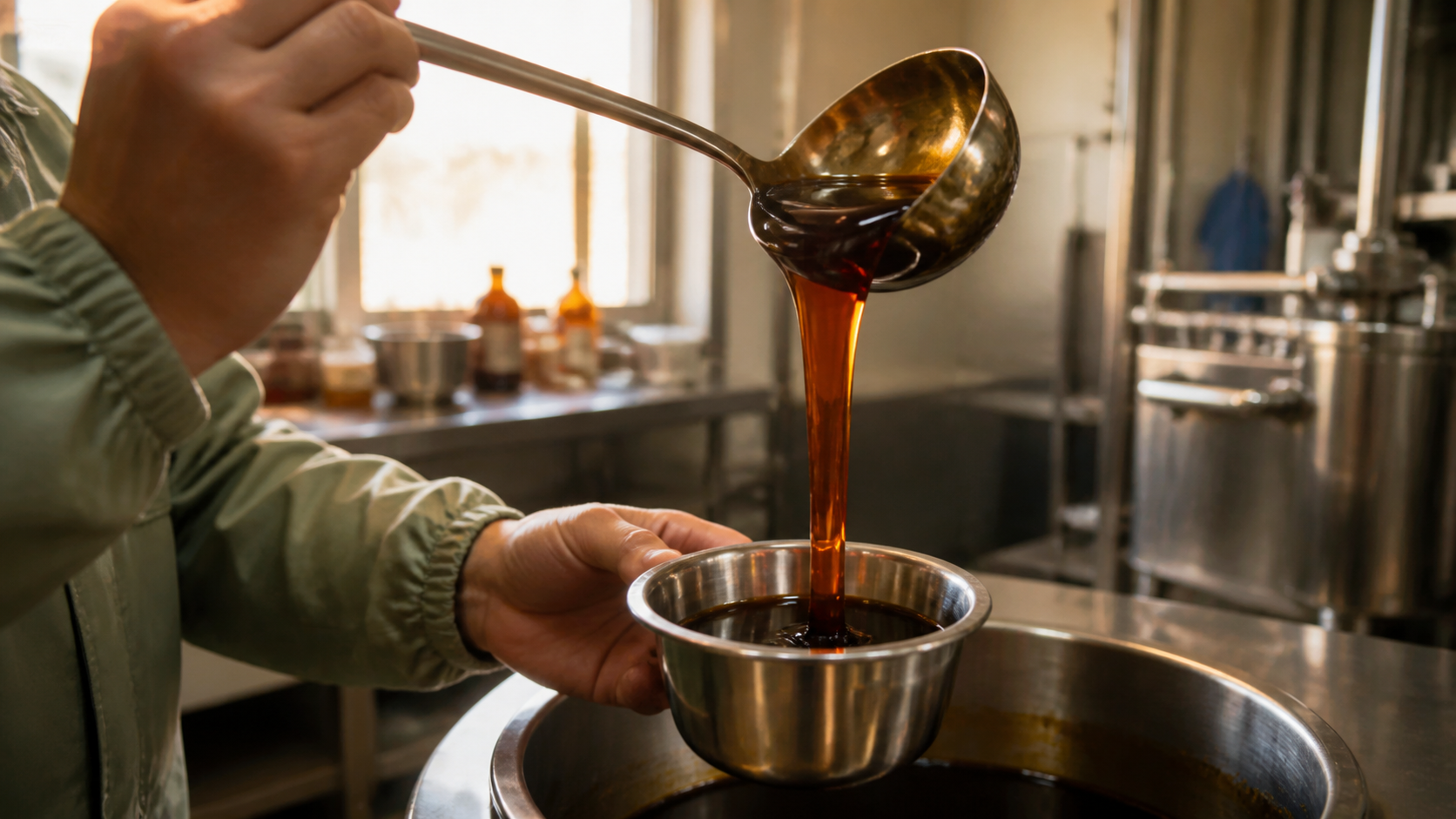
Bull-Dog Sauce approved a new capital-allocation plan on August 21, 2026, that targets a 60% total-payout ratio, at least JPY 3.0 billion of shareholder returns and JPY 1.5 billion of share repurchases over the three fiscal years through March 2029. The Tokyo Prime-listed sauce maker also plans to sell JPY 2.0 billion of policy shareholdings and invest JPY 5.0 billion in domestic growth, overseas expansion and productivity.
The useful investor question is whether that allocation can raise recurring returns, not whether the announcement sounds shareholder-friendly. Bull-Dog Sauce estimates its cost of equity at roughly 4%-5%, yet its first ROE milestone is only 5% for the fiscal year ending March 2029. The more demanding 8% goal does not arrive until the fiscal year ending March 2033.
There is another important distinction. The JPY 1.5 billion repurchase figure is a three-year allocation, not a newly announced same-day buyback authorization. Bull-Dog Sauce had already expanded its current repurchase cap to JPY 1.2 billion in July. Investors should track how the existing authorization and future purchases fit inside the new plan.
Key takeaways
- Bull-Dog Sauce plans at least JPY 3.0 billion of shareholder returns through March 2029, including JPY 1.5 billion of share repurchases, and targets a 60% total-payout ratio.
- The company will fund JPY 5.0 billion of strategic investment with operating cash flow, JPY 2.0 billion of policy-shareholding sales and at least JPY 1.0 billion of financing.
- The 5% ROE target for the fiscal year ending March 2029 only reaches the top of management's estimated 4%-5% cost-of-equity range. The 8% target for the fiscal year ending March 2033 is the clearer value-creation test.
- Reported ROE of 10.5% for the year ended March 2026 included a gain from selling the former Hatogaya factory site. Management says returns excluding that gain were around its cost of equity, but it does not disclose a precise adjusted ROE in the plan.
- The JPY 24.5 billion 2032 sales target implies about 66.8% total growth from FY2026 sales, or roughly 8.9% a year over six periods. Overseas execution is central to that target.
- This is not a shareholder-benefit cancellation. Bull-Dog Sauce says it will consider a long-term-holder benefit after expanding its existing program in January.
For broader context, ATG Press explains how dividends and repurchases fit into Japan shareholder-return policy and how the Tokyo Stock Exchange's cost-of-capital disclosure tracker is used.
What Bull-Dog Sauce Changed On August 21
The board's August 21 update turns a general PBR concern into a quantified cash-allocation plan for the fiscal years ending March 2027 through March 2029. Bull-Dog Sauce expects JPY 6.0 billion of operating cash flow, JPY 2.0 billion from policy-shareholding sales and at least JPY 1.0 billion of financing.
The cash uses are similarly explicit: JPY 5.0 billion of strategic investment, at least JPY 3.0 billion of shareholder returns and JPY 1.0 billion of existing investment.
Swipe horizontally to view all columns.
| FY2027-FY2029 allocation | Amount | What the company says it will fund |
|---|---|---|
| Operating cash flow | JPY 6.0 billion | Main internal funding source |
| Policy-shareholding sales | JPY 2.0 billion | Balance-sheet release for growth and returns |
| Financing | At least JPY 1.0 billion | Additional funding; instrument and cost not disclosed |
| Domestic strategic investment | JPY 3.0 billion | M&A, domestic share and channel expansion, production capacity |
| Overseas strategic investment | JPY 1.2 billion | Local market entry and manufacturing |
| Productivity and systems | JPY 0.8 billion | Workplace, people, digital and AI investment |
| Shareholder returns | At least JPY 3.0 billion | Dividends and repurchases, with a 60% total-payout target |
| Existing investment | JPY 1.0 billion | Ongoing investment outside the strategic-growth bucket |
The plan is more balanced than a simple cash-distribution announcement. Growth investment is larger than the minimum shareholder-return pool, while policy-shareholding sales and new financing support both sides. That puts execution pressure on management: the investments need to lift operating profit rather than merely expand the asset base.
The balance sheet provides room, but not an unlimited one. In its June 2026 quarterly results, Bull-Dog Sauce reported JPY 25.404 billion of net assets and a 70.0% equity ratio. It held JPY 12.832 billion of investment securities, equal to about 35% of total assets. The JPY 2.0 billion sale target is roughly 15.6% of that June securities balance, using carrying amounts only as an orientation point.
ATG Press's guide to Japan cross-shareholding reductions explains why investors should verify what was sold, the cash proceeds, tax effects and the use of funds rather than treating every reduction as automatic value creation.
Why 5% ROE Is Only The First Hurdle
Bull-Dog Sauce says its price-to-book ratio was 0.93 in the fiscal year ended March 2026 and estimates its cost of equity at 4%-5% using the capital asset pricing model. Its planned ROE path is 3.8% for the year ending March 2027, 5% for the year ending March 2029 and 8% for the year ending March 2033.
That sequence matters. A 5% ROE may just cover the upper end of the company's own cost-of-equity estimate. It does not create a large spread. The 8% target would be more meaningful, but it is six fiscal years beyond the current FY2027 period.
Swipe horizontally to view all columns.
| Return marker | Company disclosure | ATG Press reading |
|---|---|---|
| Estimated cost of equity | 4%-5% | The minimum return hurdle disclosed by management |
| FY2027 ROE target | 3.8% | Still below or at best near the lower end of the estimated cost range |
| FY2029 ROE target | 5.0% | Reaches the upper end, leaving little spread if the estimate rises |
| FY2033 ROE target | 8.0% | The first target with a clearer disclosed spread over today's estimate |
| FY2026 reported ROE | 10.5% | Inflated by a one-time former-factory-site sale gain |
A simple bridge shows the scale. On the June 2026 equity base of JPY 25.404 billion, 5% ROE corresponds to about JPY 1.27 billion of annual attributable profit and 8% to about JPY 2.03 billion. Those are not company forecasts; equity will change as earnings, dividends, buybacks and securities valuations move.
For comparison, Bull-Dog Sauce currently forecasts JPY 950 million of attributable profit for the year ending March 2027. Dividing that by the June equity base gives approximately 3.7%, broadly consistent with management's 3.8% ROE target.
The reported 10.5% ROE for the prior year is not a reliable recurring base. The FY2026 financial results show JPY 2.440 billion of attributable profit, while the August plan notes that the sale of the former Hatogaya factory site lifted the figure. Investors should compare future ROE with operating profit and recurring cash generation, not with the one-time peak.
The Buyback Figure Needs Careful Reading
The plan earmarks JPY 1.5 billion for repurchases over three years and at least JPY 3.0 billion for dividends plus buybacks. That is a useful commitment, but it should not be read as a fresh JPY 1.5 billion order entering the market after the filing.
On July 24, Bull-Dog Sauce expanded its existing repurchase authorization from JPY 500 million to JPY 1.2 billion and from 280,000 shares to 660,000 shares. The enlarged maximum represented 5.2% of issued shares excluding treasury stock, with purchases permitted from May 18, 2026 through March 19, 2027.
The August document does not say that its JPY 1.5 billion line is incremental to that authorization. A conservative reading is that the current program can count toward the three-year allocation. Future disclosures need to show the actual number of shares, average purchase price, cancellations, and any new board authorizations.
The dividend also matters. Bull-Dog Sauce forecasts JPY 45 per share for the year ending March 2027, unchanged from the prior year. A total-payout ratio can rise through repurchases even when the dividend is flat, so investors should separate recurring cash dividends from opportunistic buybacks.
Can The Growth Plan Lift The Return Base?
Management targets JPY 24.5 billion of group sales in the fiscal year ending March 2033: JPY 11.0 billion from domestic household products, JPY 7.2 billion from domestic commercial channels and JPY 6.3 billion from overseas business. FY2026 sales were JPY 14.688 billion.
The target therefore implies about 66.8% cumulative growth, or roughly 8.9% compound annual growth over six fiscal periods. The disclosed mix would put overseas sales at about 26% of the 2032 total.
That is a real operating challenge for a mature food company. The domestic plan depends on new products, channel expansion, potential M&A and production investment. The overseas plan requires localization and eventually local manufacturing. Neither follows automatically from selling investment securities or repurchasing shares.
Current profitability shows why the mix matters. In the June quarter, sales rose only 0.4% year on year to JPY 3.711 billion, while operating profit increased 23.4% to JPY 154 million. The margin improved, but one quarter does not establish the multi-year growth rate needed for the 2032 target.
The JPY 5.0 billion strategic-investment budget is thus the main operating test. If domestic M&A, capacity spending and overseas localization lift margins and asset turnover, the return plan can become self-reinforcing. If investment expands assets faster than profit, ROE may remain close to the cost of equity even with buybacks.
Governance And Shareholder Benefits
Bull-Dog Sauce pairs the financial plan with governance changes. It says the outside-director ratio rose from 43% to 50% and the female-director ratio from 29% to 38% in June 2026. It also added one outside director to the audit and supervisory committee and plans more investor meetings.
The company continues to review the economic rationale for policy shareholdings. That process will be more credible when investors can reconcile actual reductions with the JPY 2.0 billion target and see how proceeds are allocated.
The plan also says Bull-Dog Sauce will consider a benefit for long-term shareholders. The company had expanded its benefit program in January 2026. This filing is therefore not evidence of a yutai cancellation or a shift from benefits to dividends; it points in the opposite direction for long-term holders.
For international investors, that creates a mixed framework. Dividends and buybacks are broadly accessible to eligible shareholders, while product benefits can be less useful outside Japan. The capital-return analysis should therefore remain separate from the marketing and loyalty role of the benefit program.
What To Watch Next
Five checks will show whether the plan is working.
1. Track actual policy-shareholding sale proceeds against the JPY 2.0 billion target and compare them with the investment-securities balance. 2. Reconcile the current JPY 1.2 billion repurchase authorization with the three-year JPY 1.5 billion allocation; do not add the figures automatically. 3. Compare recurring operating profit, attributable profit and ROE with the 3.8%, 5% and 8% milestones. 4. Look for measurable overseas sales, local production progress and returns on the JPY 1.2 billion overseas-investment budget. 5. Check whether the 60% total-payout target is defined and reported consistently across fiscal years, especially when buybacks are uneven.
Bull-Dog Sauce has moved from a vague PBR concern to quantified allocation. The unresolved question is whether a mature domestic food business can turn balance-sheet changes into a durable return spread. The 2029 target reaches the hurdle; the 2033 target is where the value-creation case becomes more demanding.
The Tokyo-listed ordinary share is code 2804. A TradingView chart is omitted because `TSE:2804` returned an invalid-symbol message in TradingView's external advanced-chart widget on August 21, 2026. ATG Press's Japanese ticker and ADR guide explains why website symbol availability does not guarantee widget support.
Sources
- Bull-Dog Sauce Co., Ltd., Response to Achieve Management Conscious of Cost of Capital and Stock Price (Update) [English translation of Japanese title], published August 21, 2026.
- Bull-Dog Sauce Co., Ltd., Consolidated Financial Results for the Three Months Ended June 30, 2026, published July 24, 2026.
- Bull-Dog Sauce Co., Ltd., Consolidated Financial Results for the Fiscal Year Ended March 31, 2026, published May 15, 2026.
- Bull-Dog Sauce Co., Ltd., Expansion of Share Repurchase Limit, published July 24, 2026.
- Bull-Dog Sauce Co., Ltd., English financial highlights, accessed August 21, 2026.
- Bull-Dog Sauce Co., Ltd., Expansion of Shareholder Benefits Program, published January 23, 2026.
Disclaimer
This article is for informational purposes only and does not constitute investment advice.

